

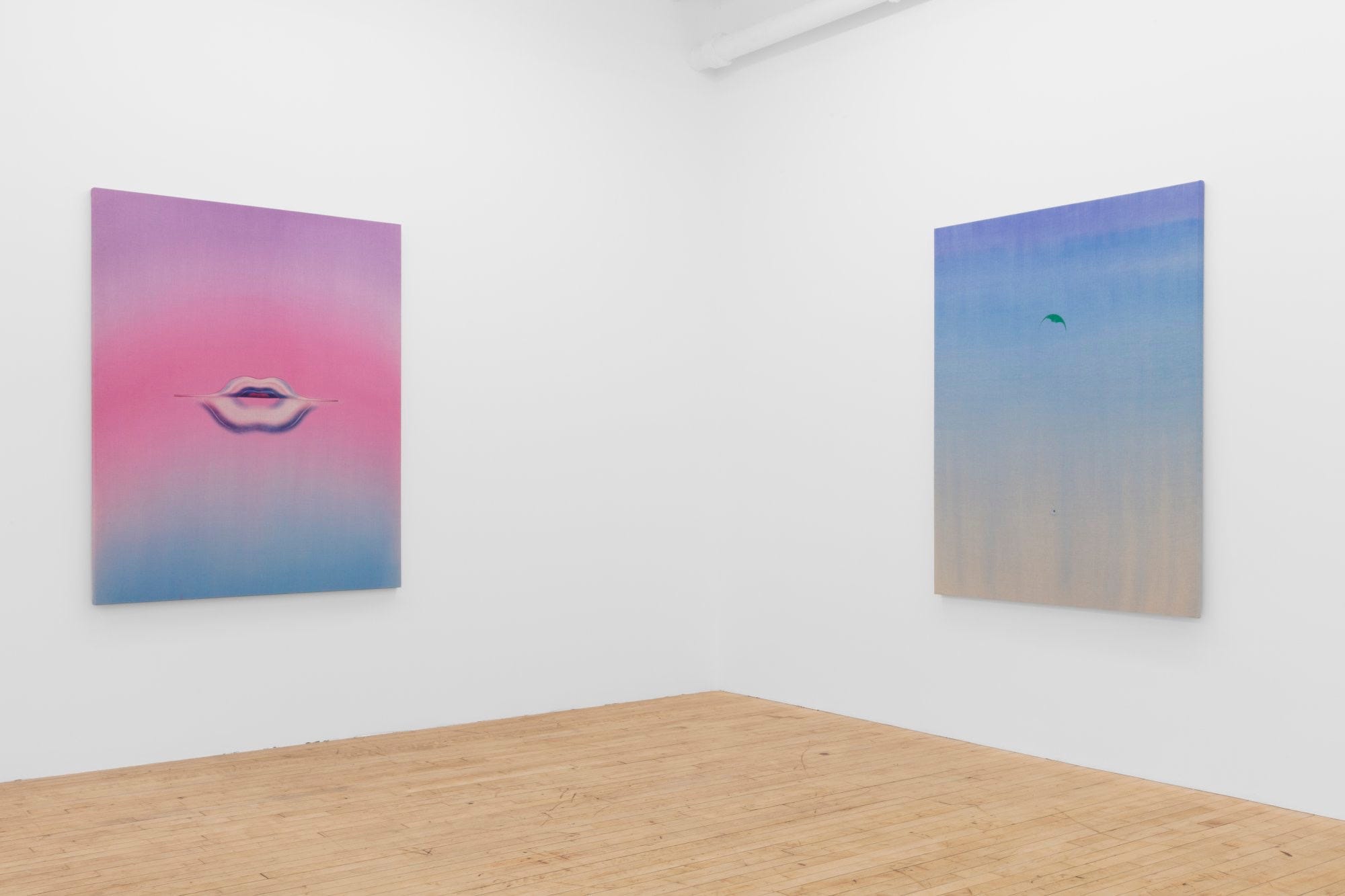
Installation view of Adam Rabinowitz: GONGONG at Oolong Gallery. Image courtesy of the gallery.
Not totally abstract, but not completely figurative. Full, but also open. Here and there at the same time. Los Angeles-based artist Adam Rabinowitz is the kind of individual that other creatives should aspire to be as his work defies any boxed categorization. His paintings are a prime example of this phenomenon, which viewers have the opportunity to see at the recently opened Oolong Gallery in Tribeca at 4 Cortlandt Alley. The emphatically titled GONGGONG is a term that carries much meaning - a dwarf planet discovered just under 20 years ago that lies beyond the parameters of the known universe (its scientific name being 225088 Gonggong); an ancient Chinese water god emblematic of chaos and destruction; and then there is a more onomatopoeic association recalling the echoing clang of a struck gong. The key behind the effectiveness of Rabinowitz’s paintings is that they are multi-hyphenate in their very nature, being possessive of a whole tapestry of meanings, iconography, and material processes producing a complex network of arresting imagery.
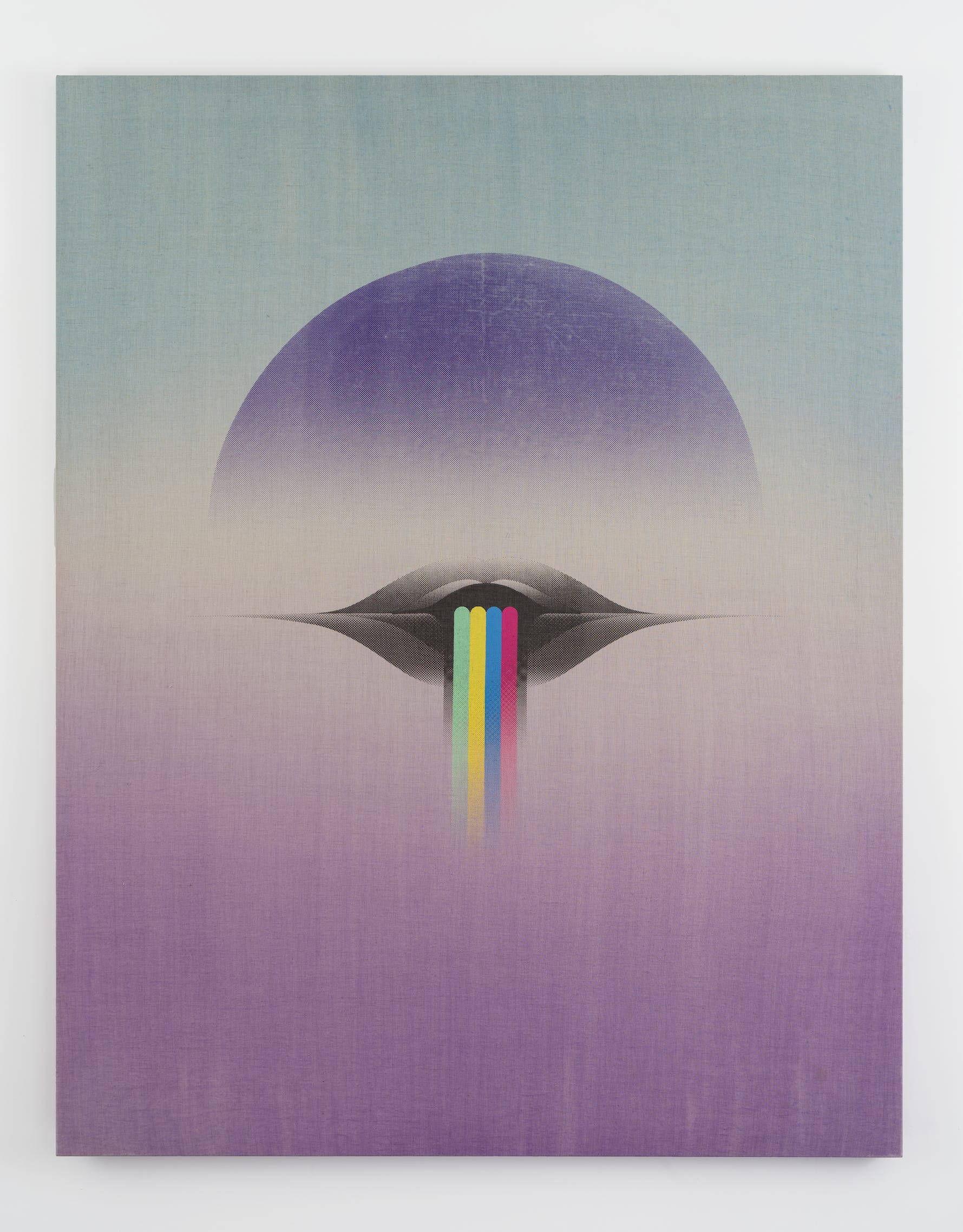
Adam Rabinowitz, Port 1, 2020, Acrylic on linen. 64 x 50 in. Image courtesy of the gallery.
The very first detail that makes itself readily apparent is the consistent color scheme that permeates each of Rabinowitz’s paintings - gradations of pink, blue, and purple and their subsequent mixtures, followed by compositions vying for more psychedelic tonalities resembling tie-dyed patterns. Before learning that Rabinowitz is based in California, the paintings automatically gave a West Coast energy that reminds one of the open sky with its warm hues hanging over the mighty Pacific Ocean. In many of them, the colors converge in the middle, producing a kind of horizon line as if looking out beyond a huge body of water towards infinity.
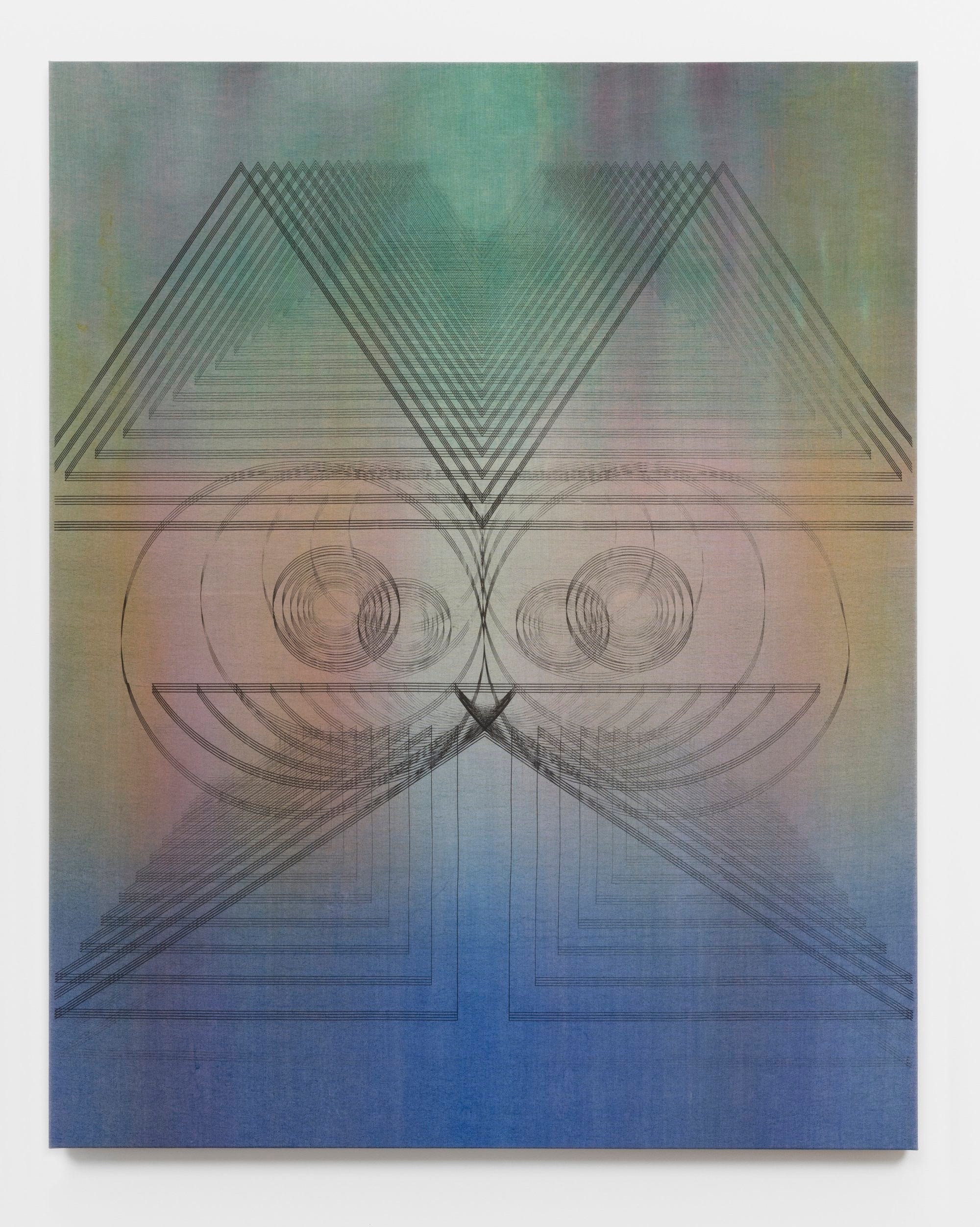
Adam Rabinowitz, Gonggong Music, 2026, Acrylic on linen. 60 x 48 in. Image courtesy of the gallery.
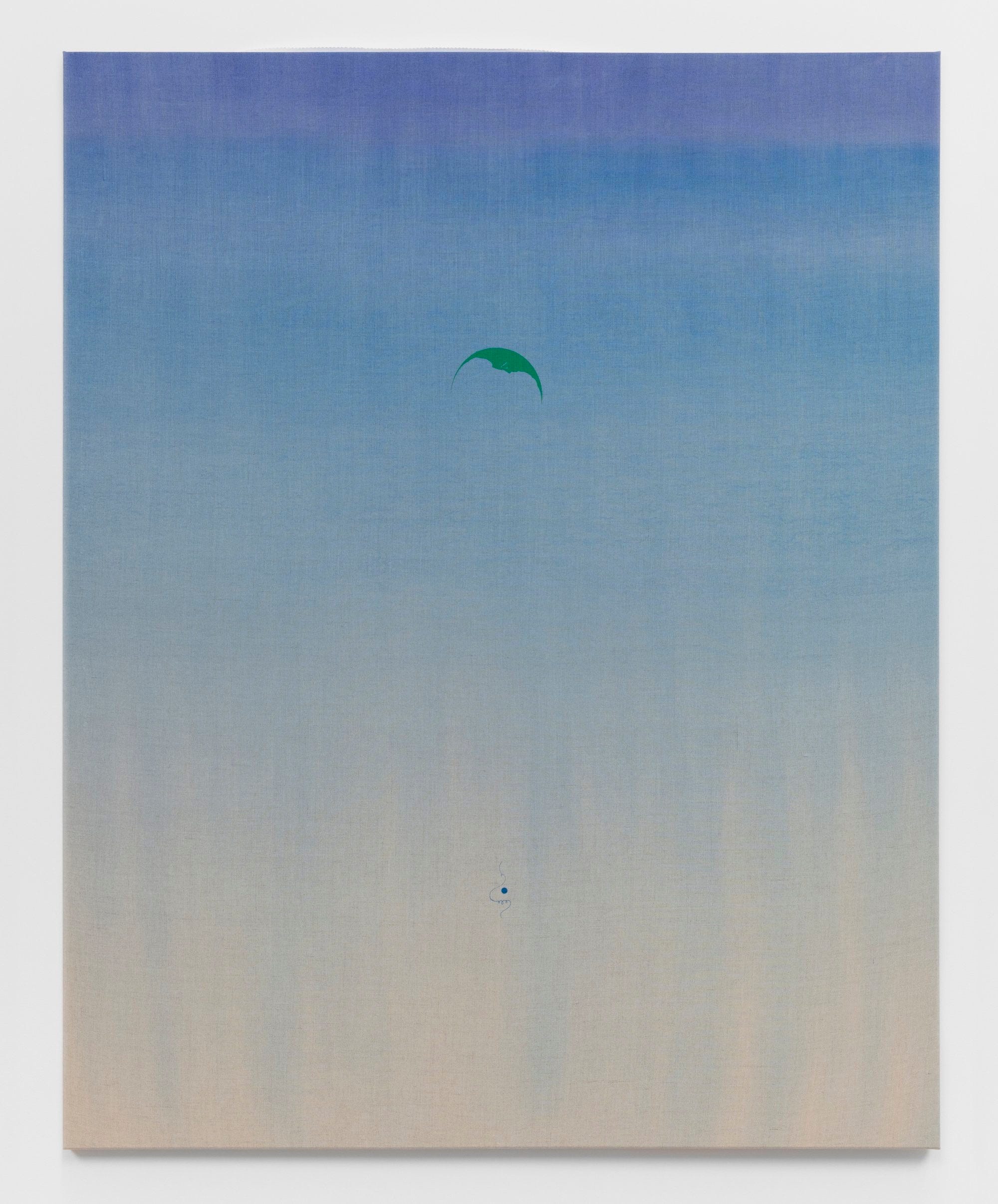
Adam Rabinowitz, Moon and Doodle, 2026, Acrylic on linen. 60 x 48 in. Image courtesy of the gallery.
Spatially, one needs to treat Rabinowitz’s works like they would one of Barnett Newman’s Zip paintings as they should be seen both from a distance and hyper-close. Stepping back, the works come across as totally abstract - the vibratory pull of an image like Gonggong Music (2026) feeling spiritually aligned with Op Art, while Moon and Doodle (2026) presents itself like an atmospheric Color Field. Getting closer, a new kind of clarity reveals itself. In the case of Moon and Doodle, most of the composition is awash in a soaked blue acrylic over linen (with a slight appearance of purple or an inky blue at the very top) that peters out towards the bottom into the exposed linen surface … and then there is one tiny figurative detail that calls your attention: a green crescent moon turned on its side with a subtle cartoonish face placed in the middle of the upper reaches of the composition. Far underneath the moon, a lacy line with a blue dot next to it floats in space; the doodle from the title striking me almost a descendent of Joan Miró. It really comes down to little details like these where questions of “is this abstract or is this figurative” becomes irrelevant.
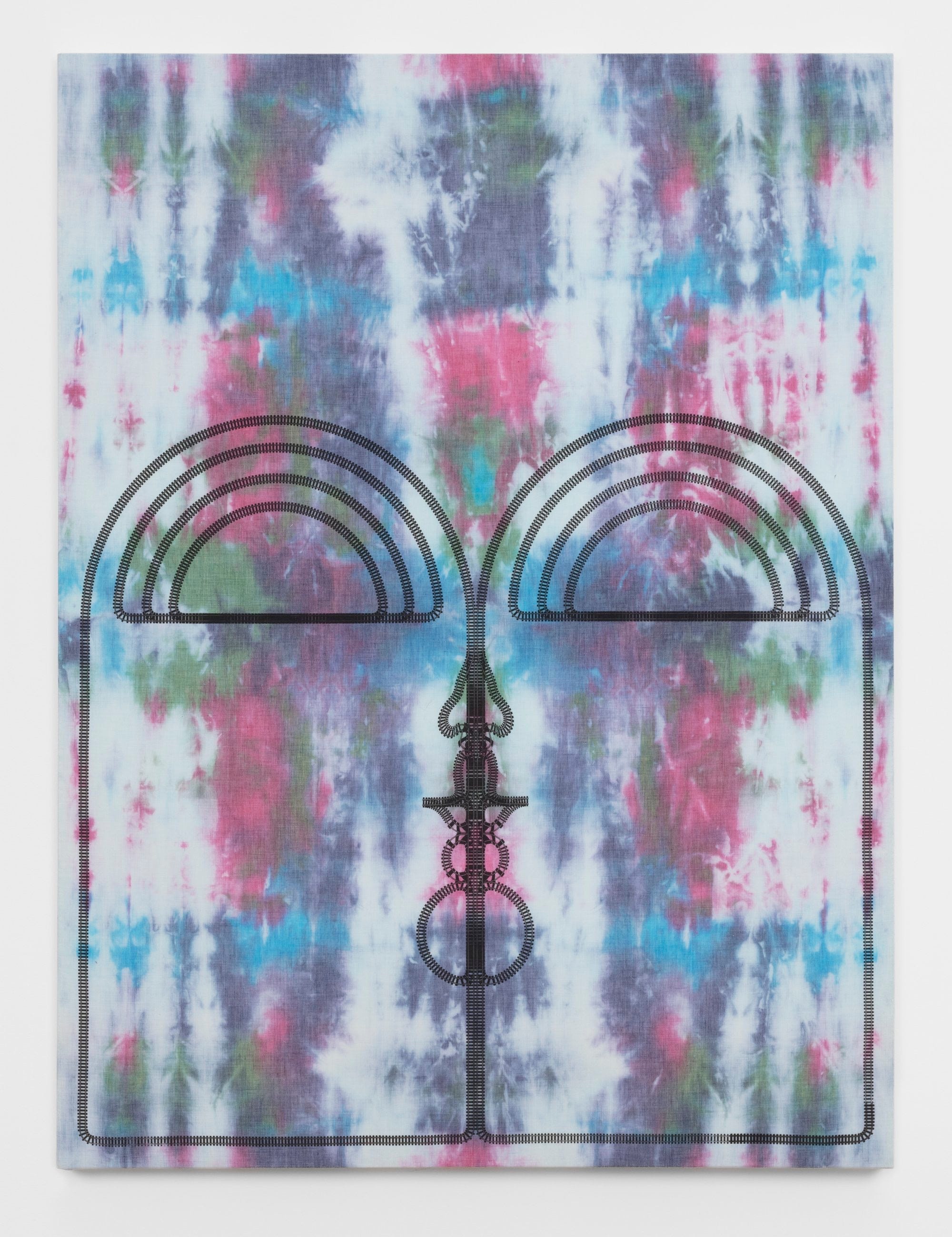
Adam Rabinowitz, Fear of Painting 1, 2022, Acrylic and dye on muslin, 48 x 36 in. Image courtesy of the gallery.
Fear of Painting 1 (2022) is one of the images with the tie-dye aesthetic, whose surface here is marked by a large-scale, perfectly symmetrical outline of a human face. Again, a closer examination leads to the discovery that the face is actually comprised of railroad tracks united in a continuous cycle that does not break off anywhere. Thinking back on the Chinese deity named Gonggong, this work is like the hidden face of a god or some kind of sentient being that gradually makes itself known to us, as if appearing through a mysterious veil of fantastic lights. The simplified, pared-down yet discernible features of the face are uncannily similar to how the Ancient Egyptians portrayed their gods and goddesses. When pondering the title, it calls to mind the oft-used expression of having a “fear of god”, sometimes as a genuine phobia and in other instances more of an awe-inspiring reverence coupled with a self-humility.
Even with these deep thematic and spiritual connections, something can be said, too, that Rabinowitz’s paintings are also like an acid trip, a serious kind of “far out” ethos, if you will. There is an inherent psychedelia behind these paintings based on their choice colors that lay a formal foundation for these indeterminate, liminal spaces with the occasional appearance of figurative and non-figurative imagery. Because he is a Los Angeles-based artist working in such a style, Rabinowitz fits into the lineage of West Coast Minimalism and the Light & Space Movement (most especially with that of an artist like James Turrell) for these exact reasons. Yet, he is not exclusive to this and should not be reduced to only these categories. Another point to interject with here is that “space” itself is not confined to the formal term, but equally so with outer space when thinking about the isolated planetary forms that exist amidst an abyss of color.
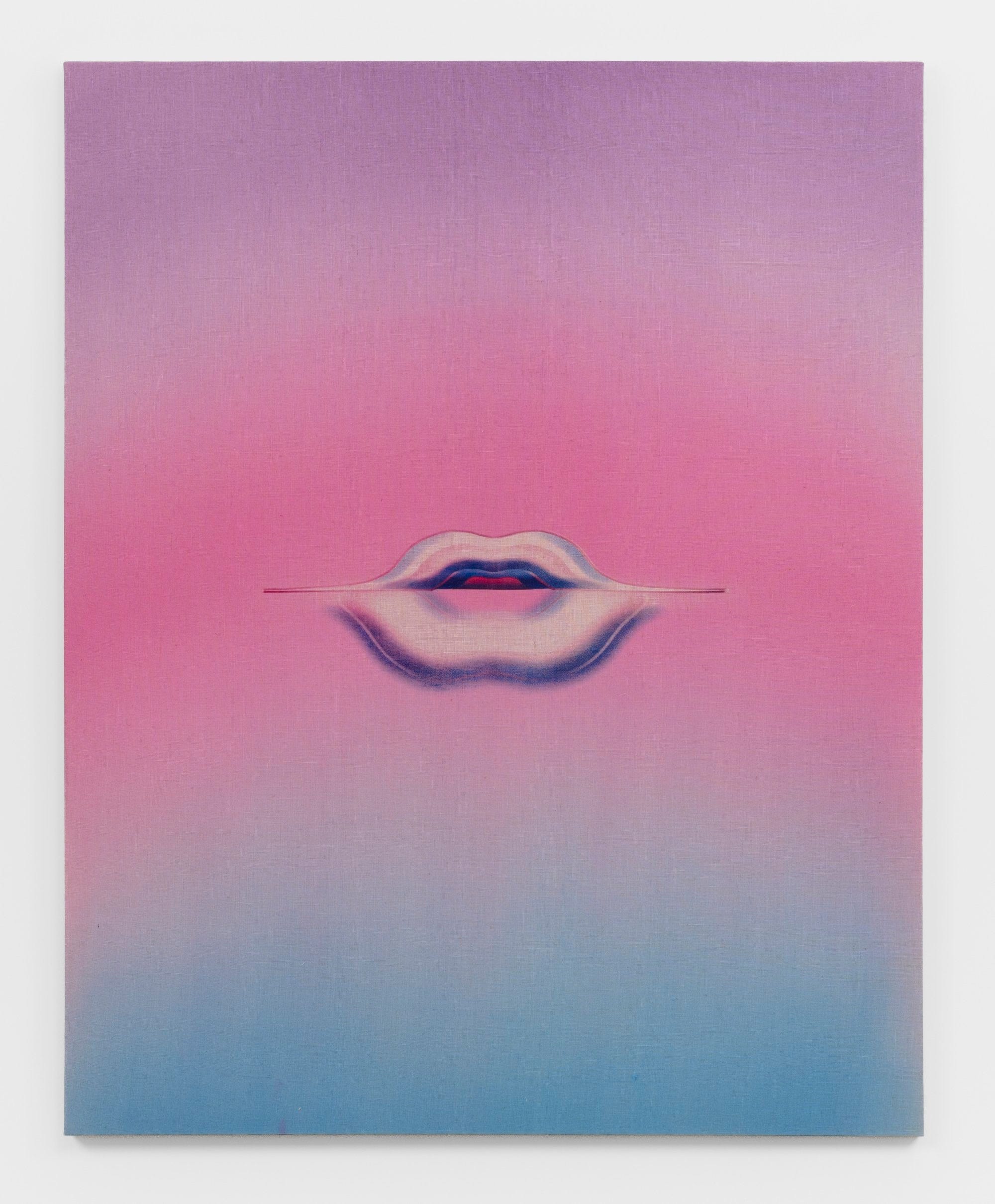
Adam Rabinowitz, Baby Jericho 1, 2022, Acrylic, dye and bleach on linen. 60 x 48 in. Image courtesy of the gallery.
Returning to the use of imagery, Rabinowitz inserts recognizable figures that have been completely recontextualized or decontextualized from their common usage - that right there feels so entrenched in a Postmodern attitude, which is a whole other system not limited to any one geographical context as it transcends that West Coast / East Coast divide. A Neo-Pop sensibility is present through disembodied cartoon anatomy like oversized eyes with exaggerated pupils or the toy-like railroad tracks whose crisp realism is a stark contrast to the airiness of Rabinowitz’s meditative zones of blended shades. Additionally, there is an abstracting of imagery into entirely new meanings - the lipsticked mouth with its plump lips from Baby Jericho 1 (2022) simultaneously looks like a melting mass oozing cotton candy colors along with a curvaceous mountain reflecting itself over a body of water; this transformation of a familiar form is in a language commensurate with another West Coast painter, Ed Ruscha, and his subversion of commonplace semiotics.
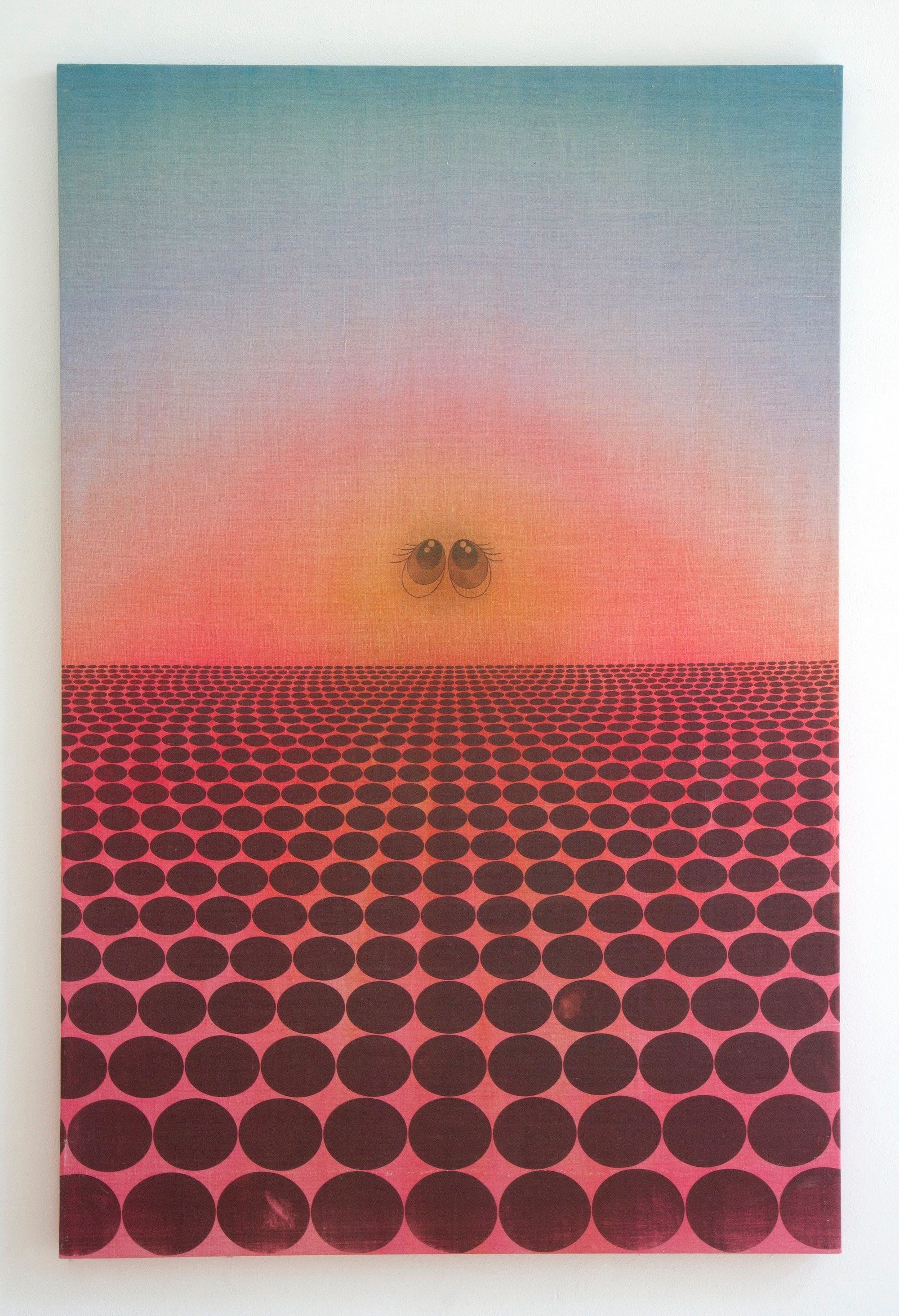
Adam Rabinowitz, Sea of Holes 1, 2017, Acrylic on linen. 65.75 x 47 in (145.9 x 106.5 cm). Image courtesy of the gallery.
Rabinowitz’s process also needs to be discussed as these are not singularly pure paintings, but an amalgamation of painting, printmaking, and textile. All of the works are on linen whose surfaces have been through a slew of material interventions by way of screenprinting, staining, bleaching, and layering. This explains the balance between visible and disappearing forms, or those caught in a firm imprinting versus those that have been soaked into the surface, thereby caught in a state of transparency or opaqueness. A mishmash of technical processes for these paintings feels right at home with the intricate details and image associations Rabinowitz weaves together.
On social media, there are many pages that encourage slow, close-looking when interacting with an artwork. One such page called Explaining Paintings (@explainingpaintings) is a great and popular resource for micro-doses of learning that often lead in with the statement “Now I understand why people can spend hours staring at the same painting in a museum.” However, they seem strictly focused on either classical paintings or contemporary narrative subjects. I think an argument can be made that an artist like Rabinowitz is equally worthy of that distinction as there is a potential for one to lose themselves within even just one of his works. It is as if you come into his paintings with an expectation that it is a specific type of art, but then the realization sets in that so much more is at play based on the close analyses I have given to a few of his paintings above.
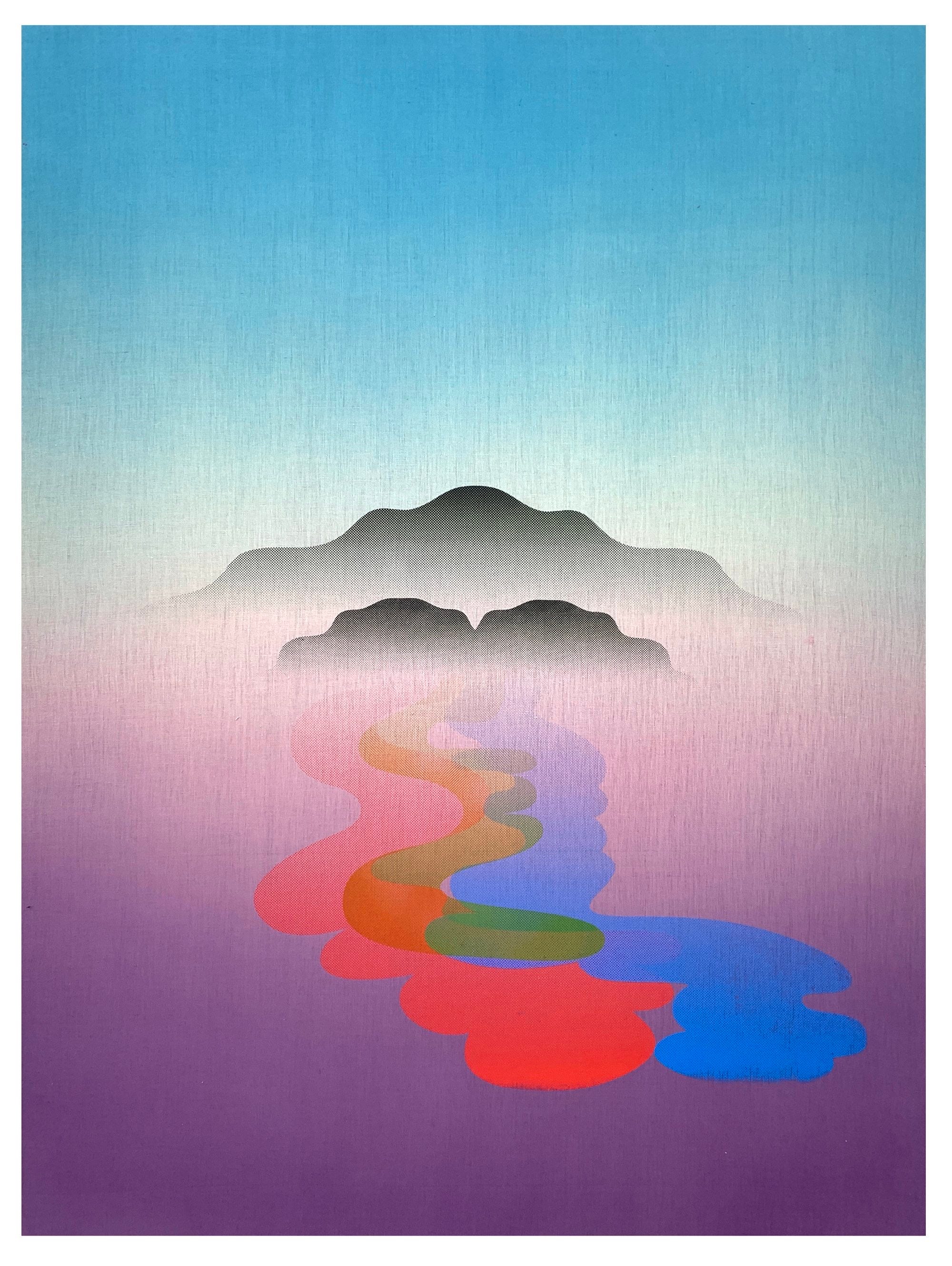
Adam Rabinowitz, Big Cloud City 3, 2024, Acrylic and dye on linen. 66 × 49 in (167.6 × 124.5 cm). Image courtesy of the gallery.
The task of attempting to ascribe Rabinowitz’s paintings according to a certain art movement or stylistic interpretation down to the “T” is futile, which is what makes his art endlessly interesting. I am convinced I could have written a whole essay on each painting to ruminate on a panoply of ideas I gleaned from studying them: Chinese literati landscapes in the case of Big Cloud City 3 (2024); calligraphic gesturality in Alien Alphabet 1 (2026); or a cross between Magical Realism and Color Field in the lunar-laden Falling Moon (2016). Rabinowitz’s paintings invite much speculation in what the eye is seeing and processing, dependent of course on one’s angle and visual referents they can bring into discussion. Traditional narrative paintings are great in their own right, but there is something uniquely satisfying about Rabinowitz’s paintings in GONGGONG that are driven by a need to decode or decipher rather than to show and tell.
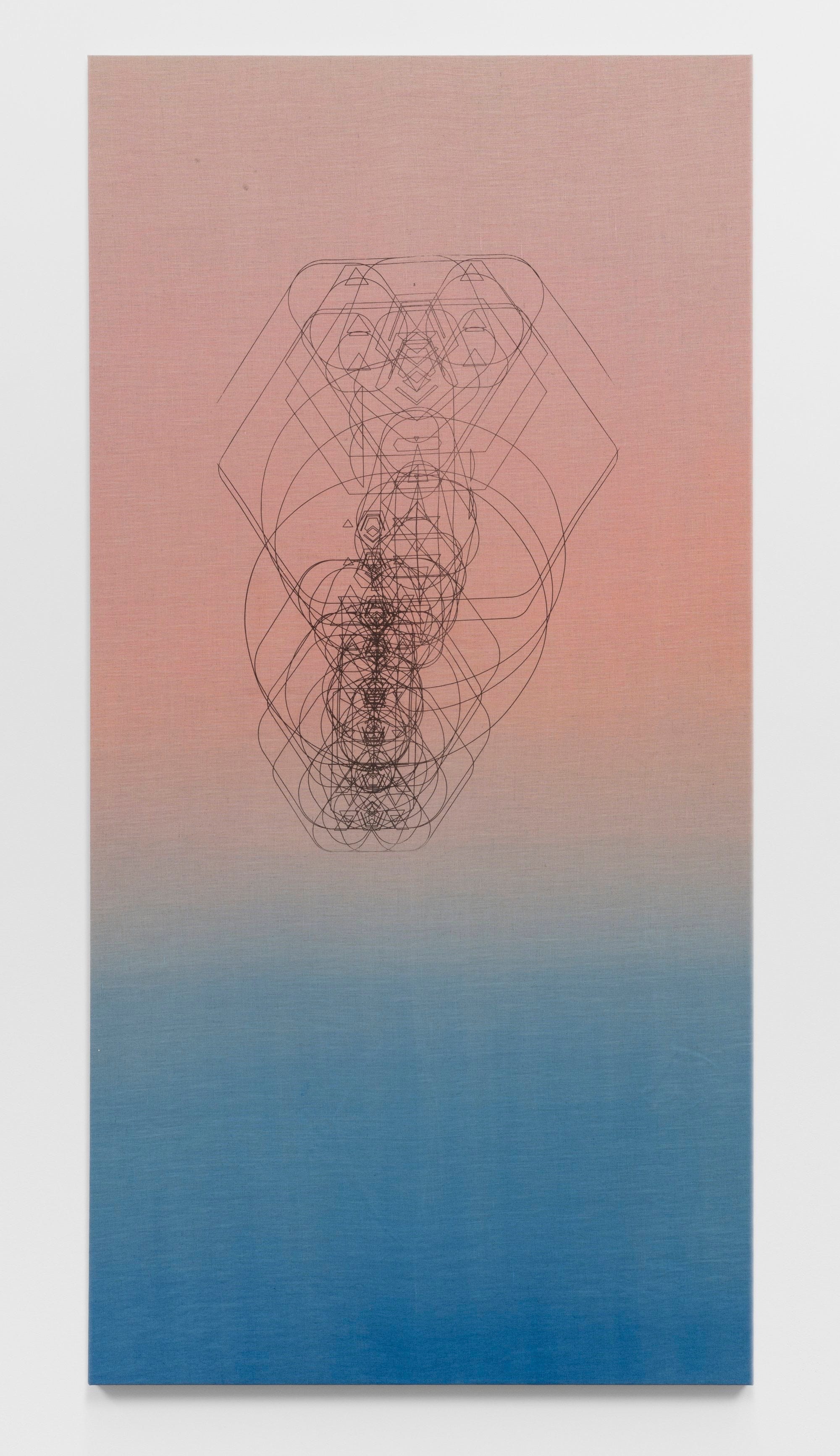
Adam Rabinowitz, Alien Alphabet 1, 2026, Acrylic on linen, 72 x 36 in. Image courtesy of the gallery.
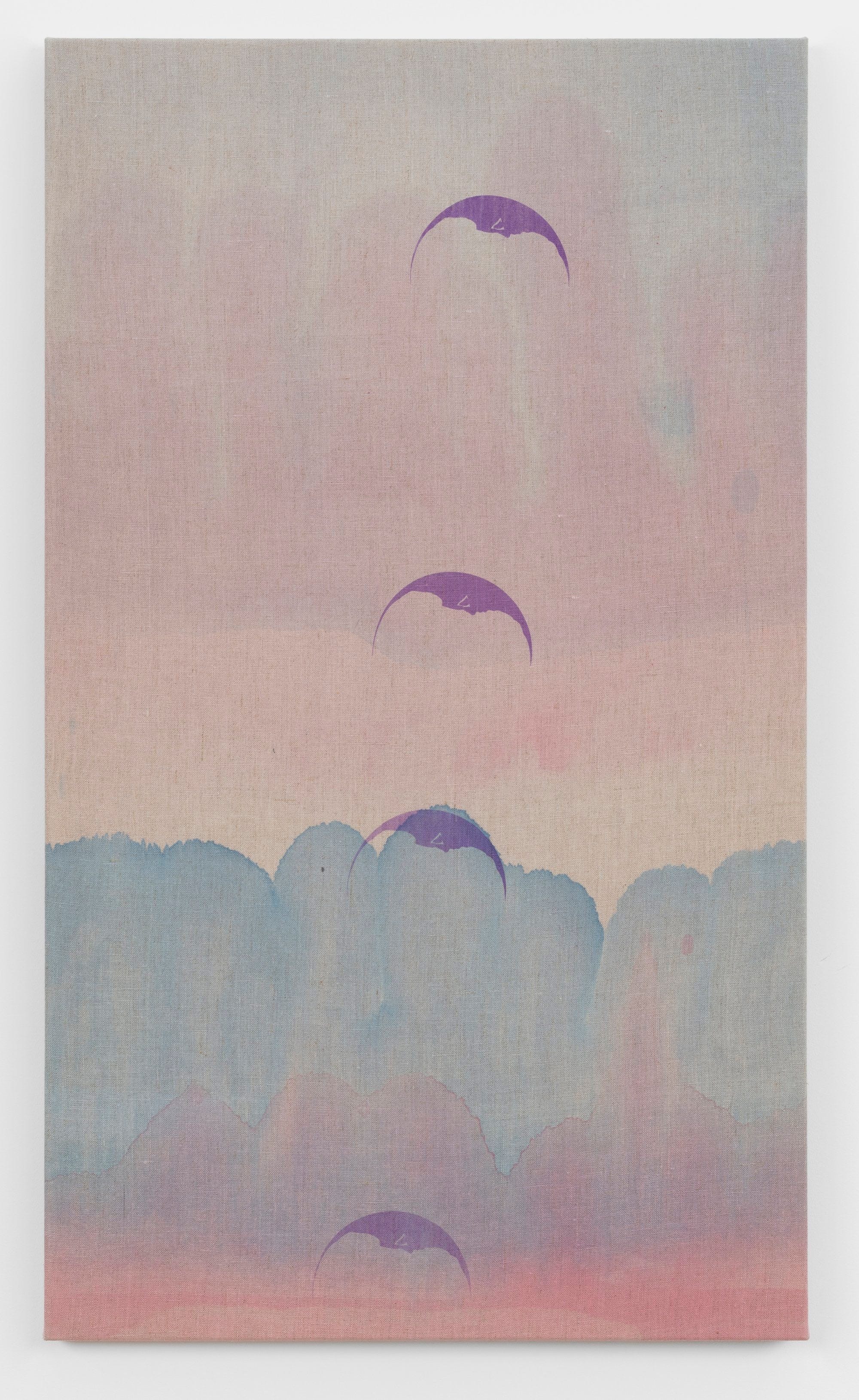
Adam Rabinowitz, Falling Moon, 2016, Acrylic and ink on linen. 41.5 x 24 in. Image courtesy of the gallery.
Not totally abstract, but not completely figurative is a hard line to walk in painting without looking indecisive, sounds like he's pulling it off. Wish I could've seen this one in person. Excellent read! Thank you!