As a specialist in Modern & Contemporary Art, I realize that the theme of memory feels so of the now in recent art. I’ve learned a long time ago not to give in to absolutes in Art History for I am sure that a great many artists have addressed this theme in some way, shape, or form in the last, say, 65 years. But since the 2010s, it appears that memory has become one of the most prevalent themes in Contemporary Art. Not only have I seen hundreds of shows that made mention of this, but also artists who dedicate entire series or even their whole practice to such concepts.
Painting is a fitting medium to delve further into this idea because this is the medium-specific terrain through which mnemonic concepts and physical presence (i.e. the artist’s hand) converge in a melding of objective reality and subjective perception. The BLANC, a contemporary art gallery in Midtown practically a stone’s throw from the main branch of the New York Public Library, exhibited works by two young artists whose paintings, though different in style, seem entrenched in the mystery of anemoia, a psychological term used to describe a longing for a time or place that one has never actually experienced but yet feels a strong attachment towards.
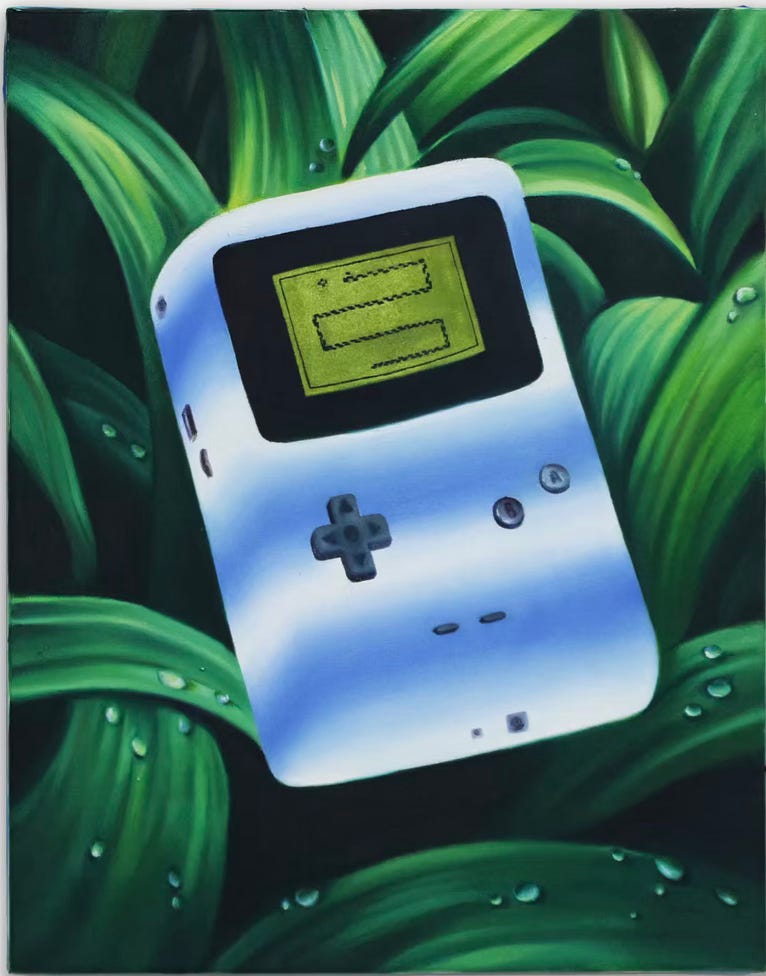
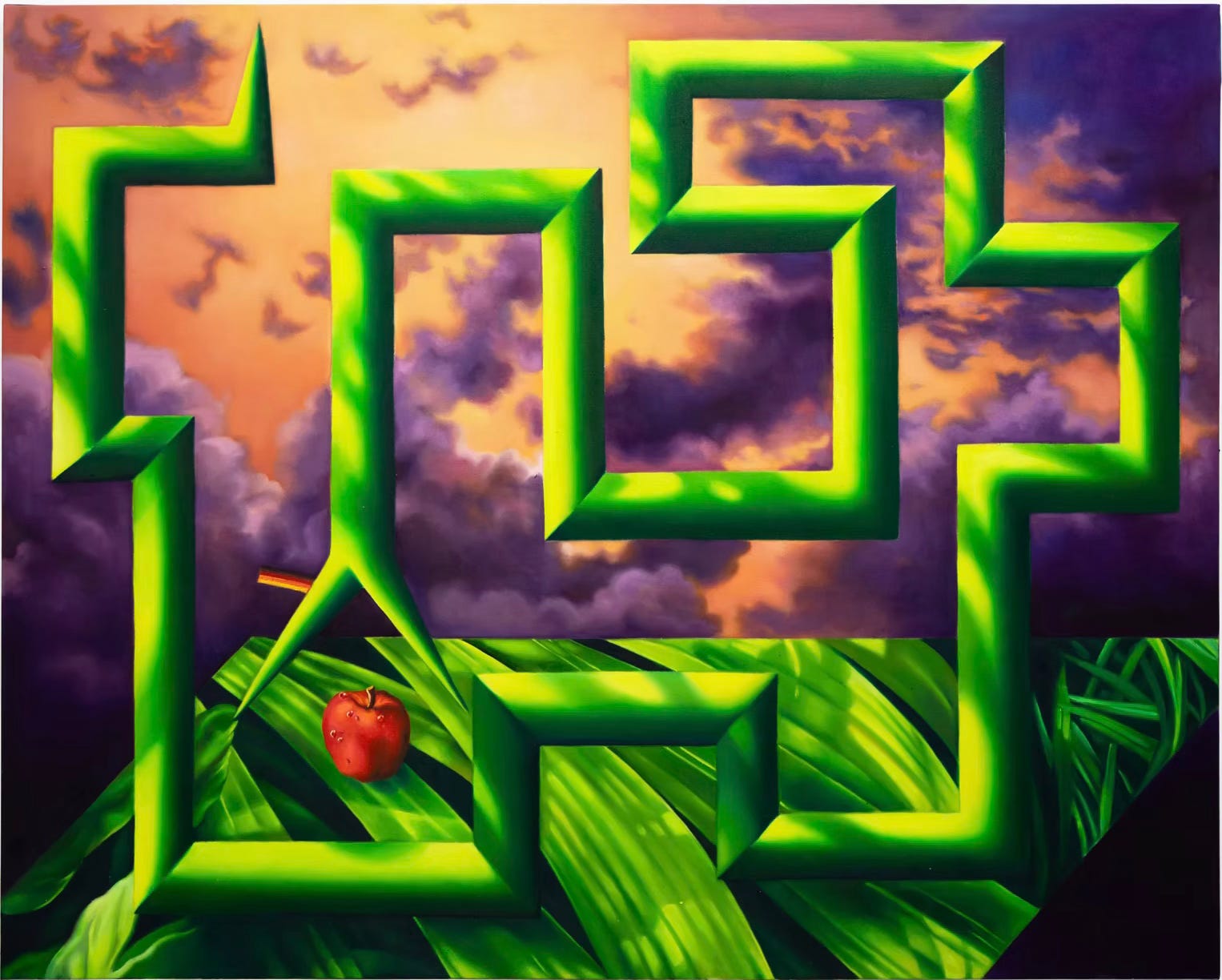
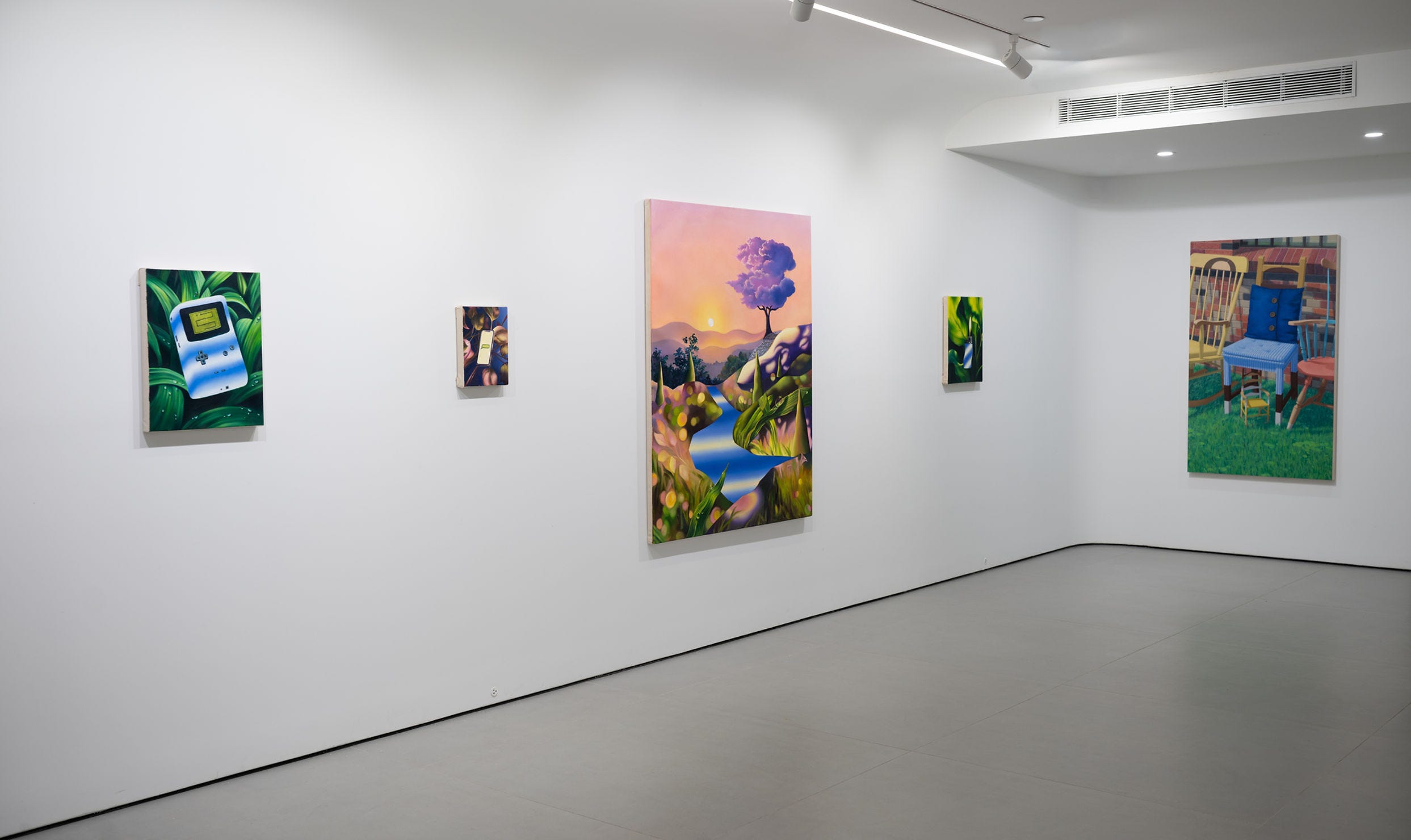
Qin Tan (Chinese, b. 1993) paints ordinary objects and spaces that are imbibed with an ethereality denoted by their unnatural lighting and coloration in tandem with a high contrast between textural verism and glossy flatness. These interstitial spaces could very well be a fragment of a moment in time one is recalling with half of the details in total clarity and the rest left up to filling in those memory blanks. The extreme attentiveness to hyper-coloration, particularly in the predominating shades of purple, seems more evocative of an implied half-dream / half-reality.
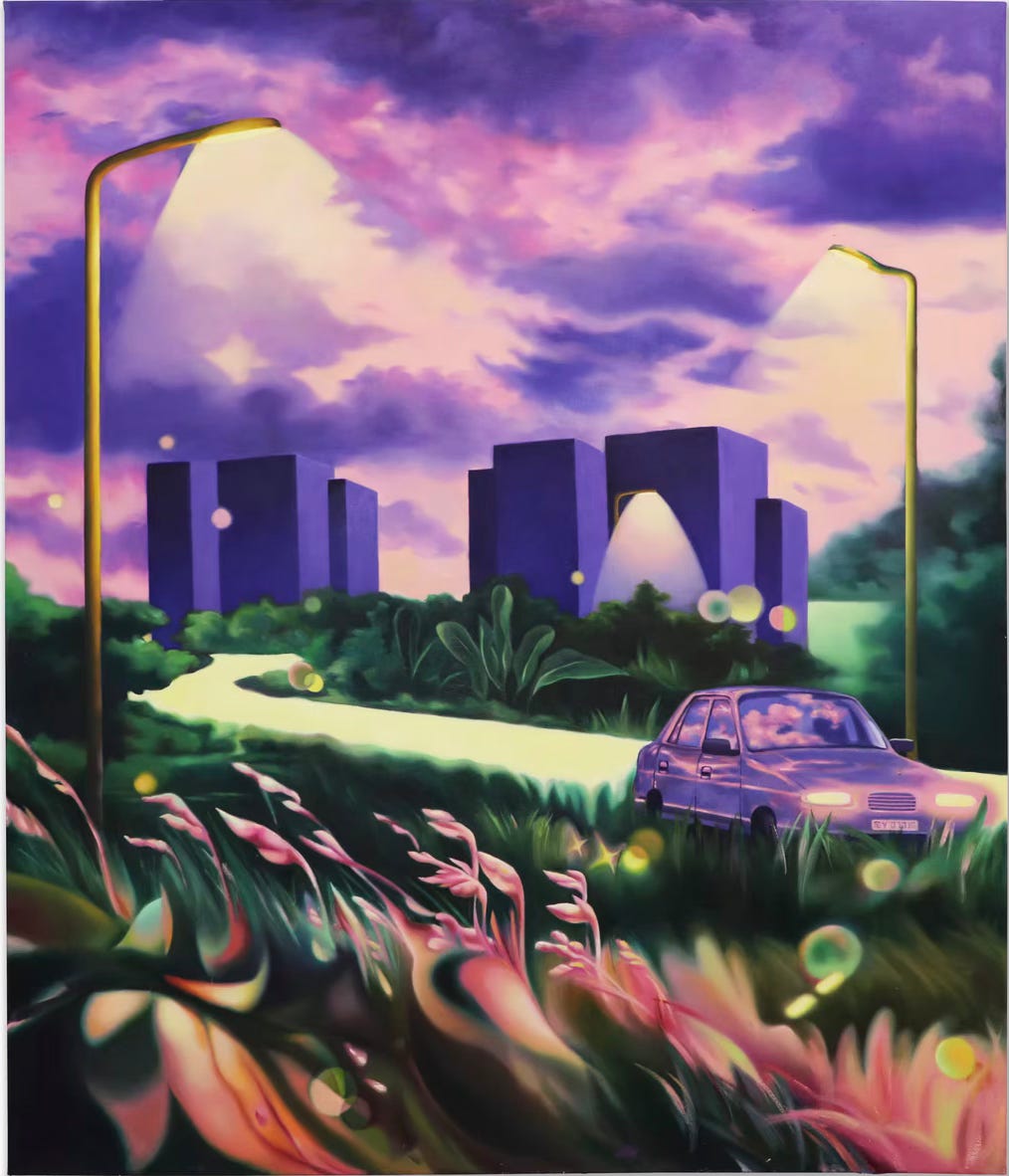
One of my favorite paintings by Tan, The Hometown I Will Never Leave (2025), I think should be regarded as the centerpiece of what their work expresses. This 58 x 68 inch painting appears to be set during sunset as a car weaves its way along a curvy road under the yellow luminescence of road lights. The scene is semi-rural partly because of the surrounding foliage, but yet there are two clusters of low-rise buildings rendered as completely flattened, featureless forms awash in darkened shades of purple that complement the mixed tonalities in the sky. The road does not even look like a road, but more like a river with the strange greenish-yellow lighting it emits akin to that of a firefly. The foliage, both the windswept flowers and tall grasses in the foreground and the distant trees in the background, are mostly represented as a blur. There is an incredible level of recognizability juxtaposed with a hyperreality that could strike one as a glimmer of a distant memory seized for a moment, but perhaps even a dream. And by dream, I do not mean something completely formed out of the imagination, but the way our subconscious pieces together fragments of what we encounter in our lived experiences with a plenitude of other images mixed together.
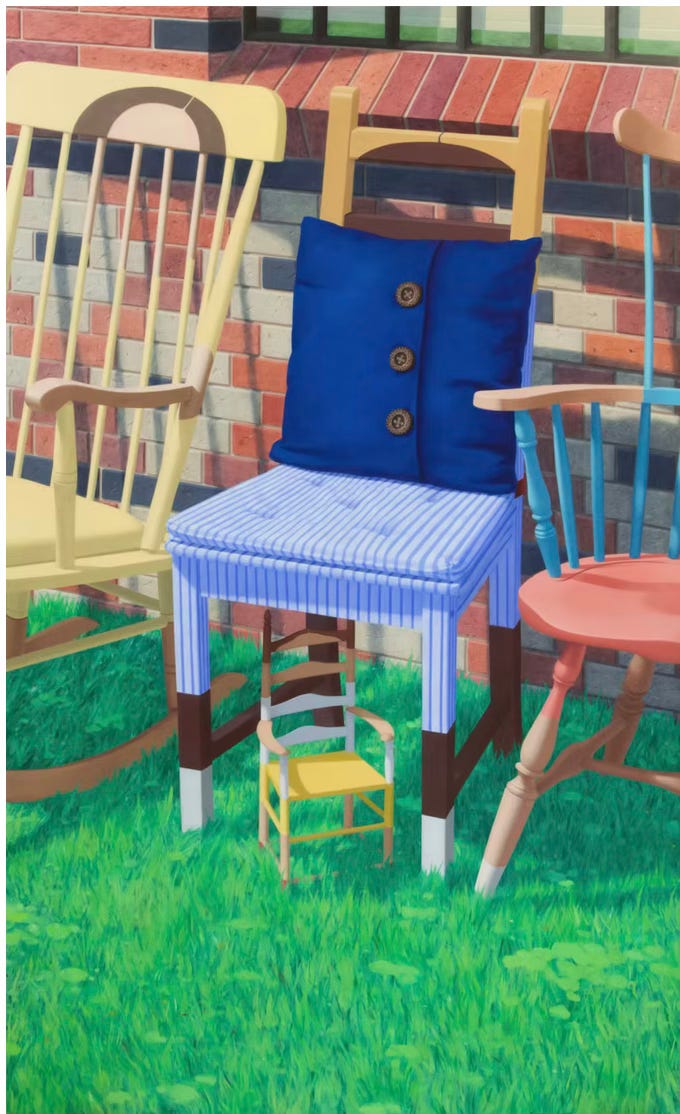
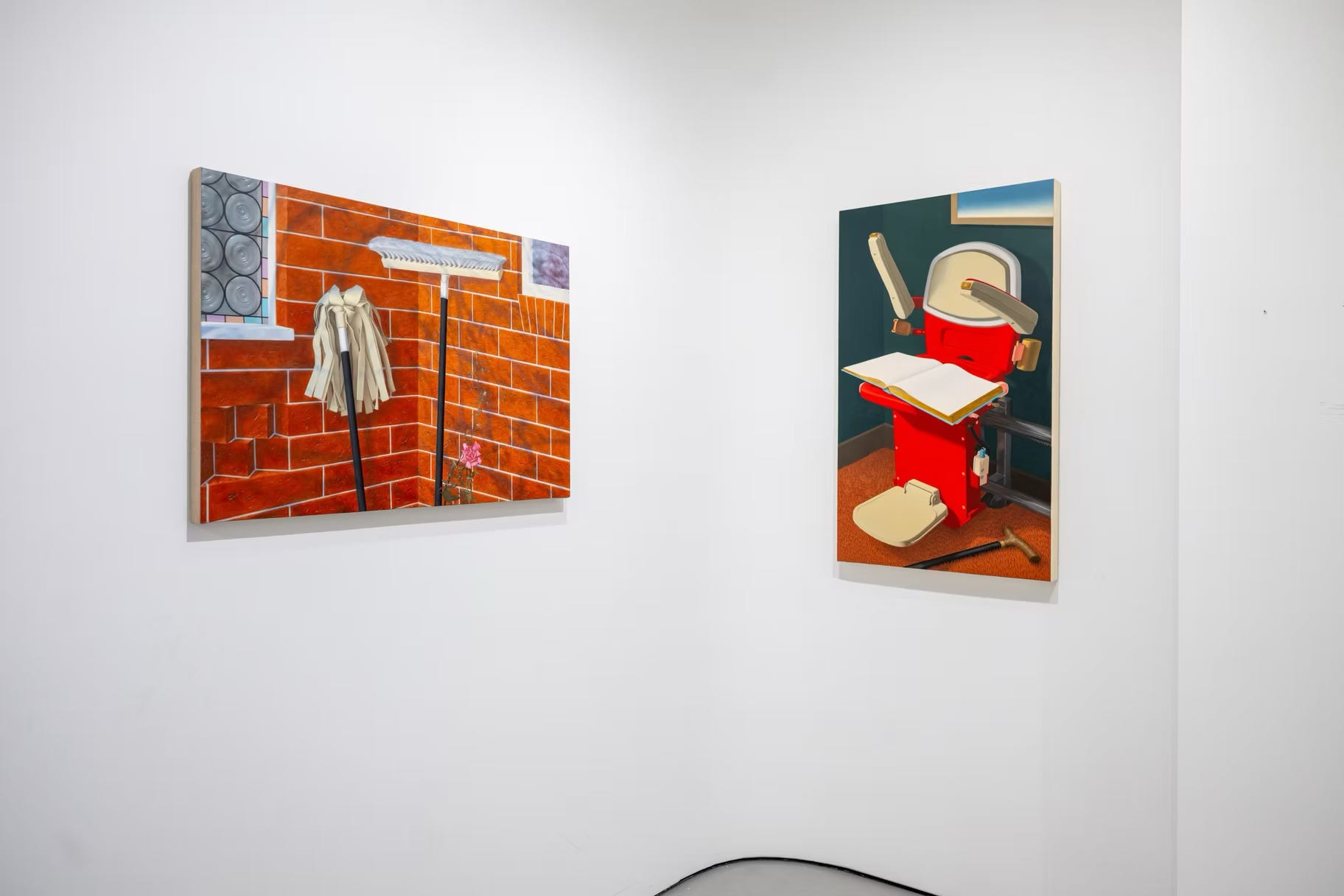
Shangkai Kevin Yu (Taiwanese, b. 1987) plays with memory through an unconventional brand of portraiture disguised as still life paintings. Perceptual questions naturally emerge when observing Yu’s works: are they animate or inanimate images? Personified subjects or implied figuration? Garden Party (2021) is an excellent painting to analyze with these questions in mind because the composition itself is quite easy to describe yet belies so much more character the longer you stay with it. Within the narrowed dimensions of this 60 x 36 inch painting, four wooden chairs are grouped in a backyard against the brick facade of a home. With three of the regularly-sized chairs positioned side-by-side and a significantly smaller one right in front of them, it becomes evident that this scene is supposed to invoke a family portrait. Ignoring the sizes of the chairs for a moment, their bespoke designs reveal individualized “personalities” or “personas”: the center chair’s buttoned cushion and fabric patterning, the rightmost’s older structure, or the tiny chair’s supportive extra ladder runged-back.
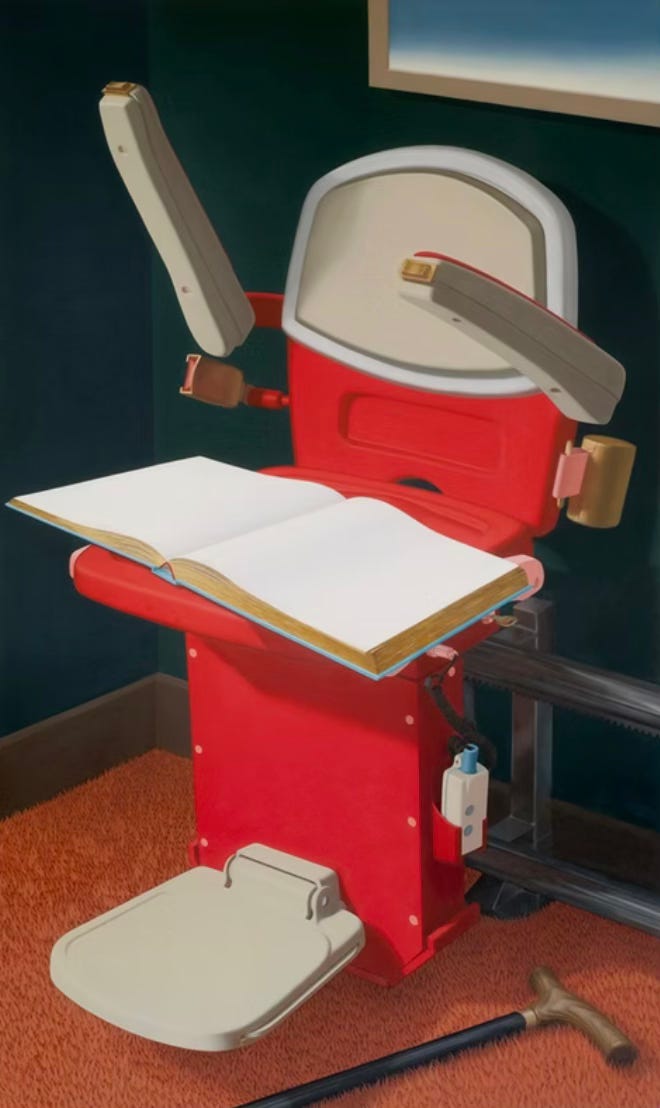
Another painting by Yu that also challenges our perception of the mundane is Jerome (2019) in which a motorized floor lift chair, a common home convenience for the elderly, is suddenly awakened with the inner life-force of Saint Jerome with its dramatically raised armrests, blank yet heavy book resting along its lap desk, and even the cast aside cane on the floor. Yu’s work could be discussed as possessing something of the Italian Renaissance painter Giuseppe Arcimboldo’s Mannerist disposition, but I do not think it is applicable here only because Arcimboldo’s work - who was known for painting images of people made of assorted objects like vegetables, books, or fish - is too on-the-nose. Where Arcimboldo’s work was more of an overt experimentation with implied figuration, Yu’s paintings leave us wondering if what we are looking at is mere coincidence or animism in action.
The pairing of Tan and Yu for this exhibition was a brilliant decision by the curator Leo Yuan as there are major commonalities between how one visually absorbs their paintings. Speculation is an integral characteristic as Tan’s paintings are borderline real-world bound and dreamworld connected, while Yu’s works may or may not be considered proper still life or portraiture (or rather neither). There’s also the matter of the use of quotidian subjects and places that, whether we have experienced them or not, feel so familiar to our senses (the anemoia connection). Tan’s paintings could be the replayed, albeit altered memory of a place we have passed through that presents itself in our mind’s eye a few minutes before we awaken from sleep, while Yu’s images are the product of what happens when we let daydreams or our imagination run amok and begin to notice signs, symbols, glitches, or what have you in our immediate surroundings.