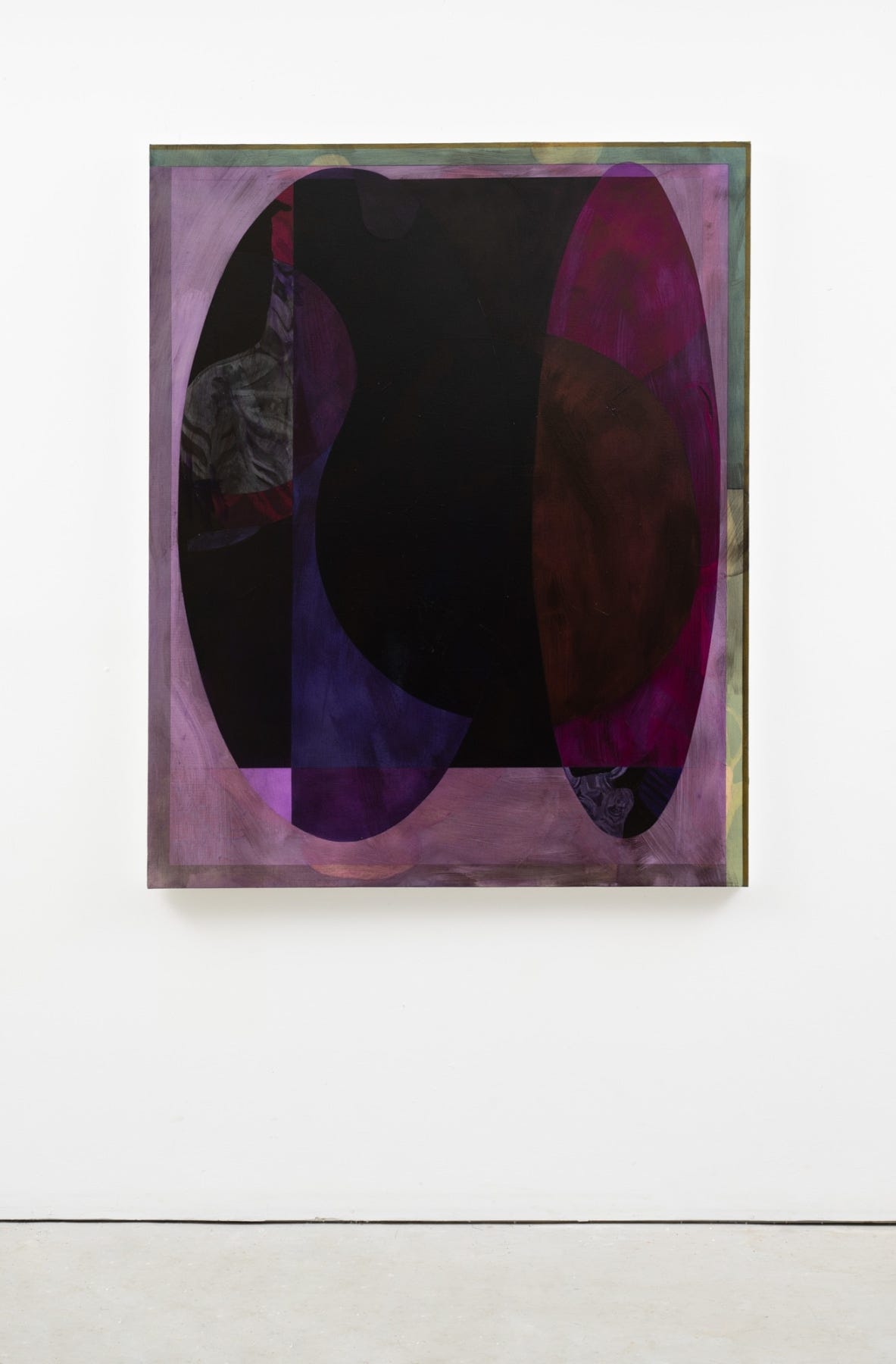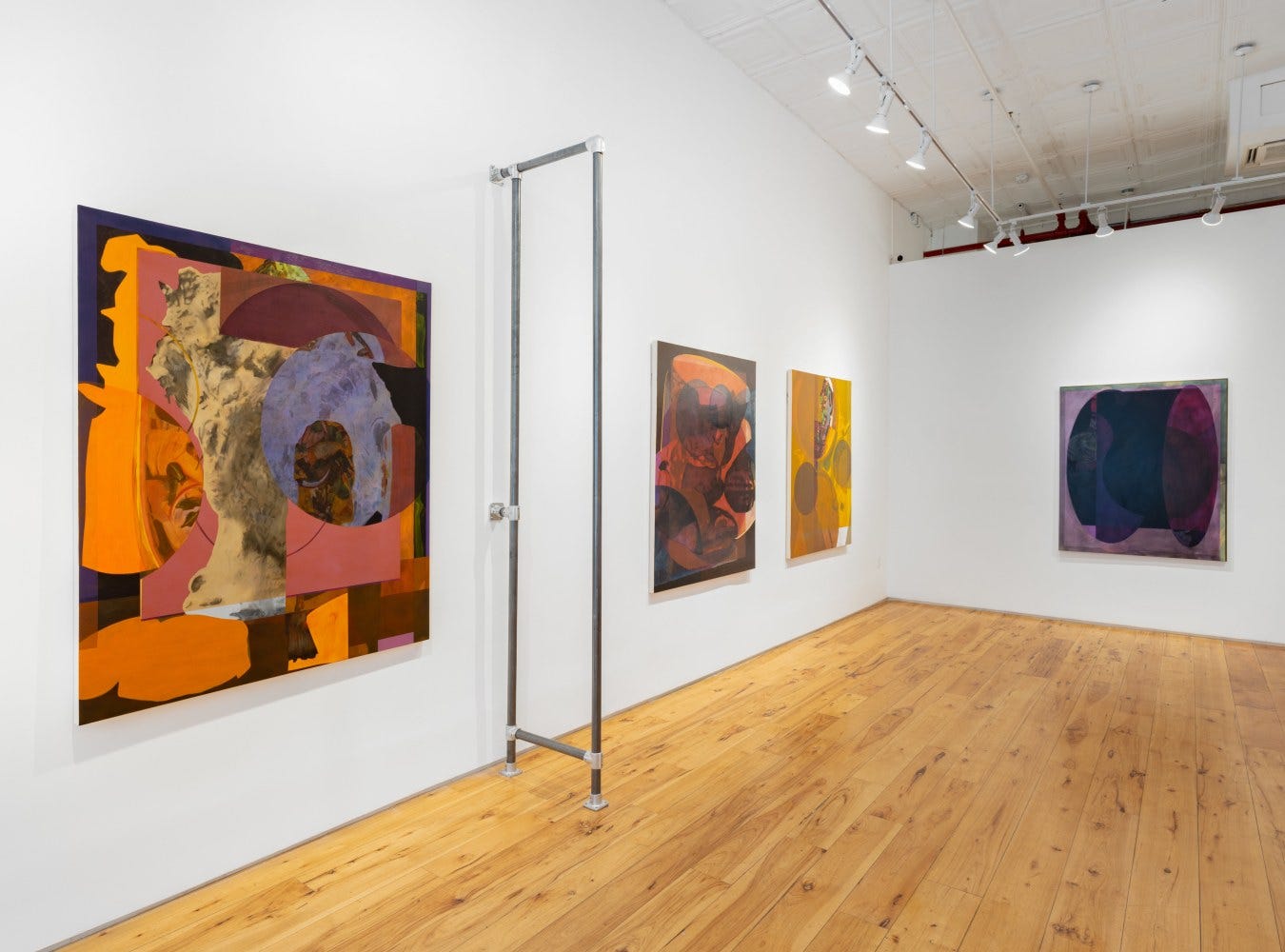
Vision as subject and vision as tool or guidepost was the overarching idea behind Derek Franklin’s recent solo exhibition at Freight + Volume Gallery. Part of the exhibition’s success stemmed from my first-time engagement with Franklin’s paintings in the gallery’s previous group show, So Sweet … So Perverse, which ultimately answered questions as to where Minimalist painting & sculpture are headed in Contemporary Art (I wrote a glowing review on that show for Whitehot Magazine). Franklin (b. 1981, Helens, Oregon) contributes a more theatrical bent to the Minimalist discourse through paintings, sculptures, and site-specific installations to be traversed from around and within - in many instances, where you physically position yourself can have a dual transformative affect on the types of imagery or framing devices achieved between works.

Freight + Volume is not a white cube gallery with four evenly proportional, uniformly colored walls, but instead is a space with a rectilinearly convex-concave layout enmeshed between white and exposed brick walls of varying heights. In my conversation with Franklin during a one-on-one walkthrough of the show, he was undeterred about the physical space as he found the gallery’s architecture to be a proving ground for curatorial experimentation. In fact, he also found great potential in transforming a space according to his creative vision in a 2023 exhibition, Grief is On My Calendar Everyday at 2:00 P.M., at the Elizabeth Leach Gallery in Portland, Oregon under similar circumstances. I stress these points because this is not so much a standard painting & sculpture show driven by a purely formalist methodology, but rather a more conceptual exhibition in which the ideas set forth undergird their appearances and how the viewers visually and spatially interact with them.
First, if you ever have the opportunity to meet or attend an artist talk with Franklin, please do so because he has a beautifully poetic and soft-spoken descriptiveness to his practice in which every sentence latches into your consciousness, never to be forgotten.

Obfuscation or veiling plays an integral role in Franklin’s oil paintings. TOS (Theater of Survival) #41 (2024) is one among many paintings in this series in which imagery - some clear and recognizable, others more disguised or deceptive - come in and out in your line of sight. The viewing experience is never the same in whichever direction you face or number of times you devote to studying the imagery. Here, I could discern a water jug (itself in the style of a 17th Century Dutch or Spanish Baroque still life), a possible wine glass turned upside down, and a dense layering of gold, brown, and orangish circles or orbs that sort of function like spotlights on a stage. My takeaways from what the painting contained evolved every so often whenever I paid it another thorough looking over (between three separate visits, and within the same visits).
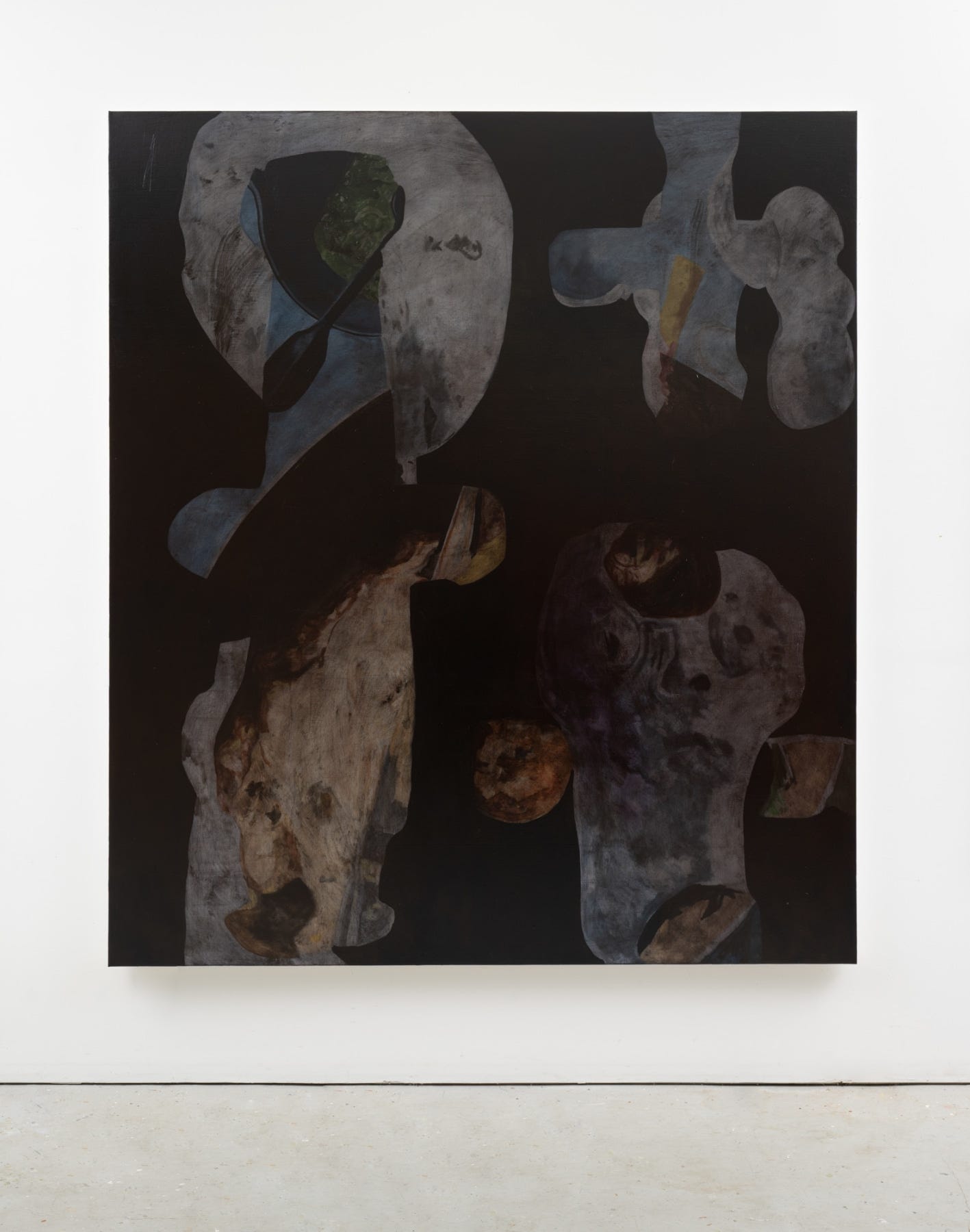
TOS Theater of Survival #38 (2025) follows the same trajectory, but on an enlarged scale and with a much darker surface. In the four corners of the canvas, it initially seems like four amorphous shapes are just barely emerging from a pit of darkness. However, closer looking and extended time spent with the painting reveals that they are clusters of images of actual objects slowly coming into view. The most recognizable of these is the painted fragment of an Ancient Greek sculptural head in the lower right corner that is represented as disembodied and partially damaged with chipped or missing edges.
Theatricality informs Franklin’s work, but not in the way with which we would typically associate the term as connotative of expressiveness and charged emotionalism. Rather, he is treating it here as a zone of vision defined by spatial closeness and distance - the audience’s relationship to the stage along with the role of the proscenium arch as a literal framing device that demarcates fictive performance from spectatorship. Furthermore, choreographed positions and light-dark contrasts also are suggestive of theater as a space in which images are revealed or concealed according to a subjective intent.
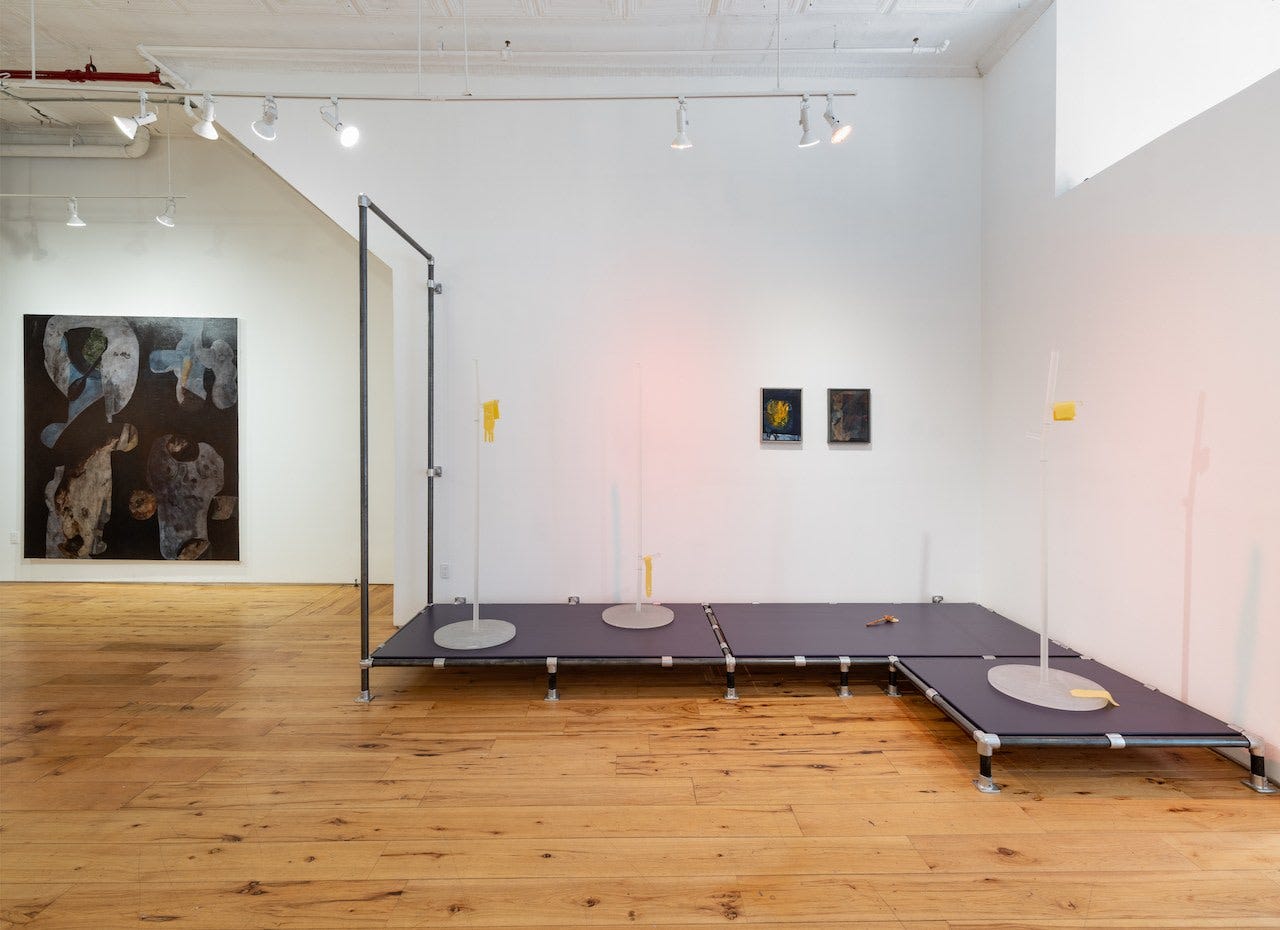
And now, this is where those site-specific installations enter my commentary. A framing device is articulated by a narrow rectangular window of metallic rods that jut out from the leftmost wall. Walking around the piece, it is evident that this object operates like a proscenium arch on a far more reduced physical scale in shaping our perceptions of the works as they relate to the space. Off to the right were more of these rodded structures in tandem with a stage-like platform fitted into an L-shaped layout comprising these almost icy-looking circular stands with faux Swiss cheese-shaped gloves hung in oozing stretches, as if to say that some of the imagery or implied / suggestive content from within the paintings have been translated into three-dimensional form. If you’re into conceptualists like Barry Le Va (American, 1941 - 2021) or Liam Gillick (British, b. 1964), then Franklin’s work must enter your roster of notable artists to follow.
Franklin’s exhibition was quite intellectual in its execution, but not in a way that came across as overly didactic or in over your head, for he deliberately made it aesthetically and curatorially palatable in one’s reception of the works and the show as a whole. You don’t need to be versed in art theory or philosophy of the senses to appreciate Franklin’s art, for the act of just seeing the works singly and collectively makes for an eye-opening experience that will only improve upon your understanding of how to observe and process the world around you.